- Lecture
On October 9, 2026, at 4:30 PM
(L-13) Past, present, and future of surgical prosthetics and epithetics
Referent: Sylvia Dehnbostel I Celle, DE
Summary:
From antiquity to reconstruction to the present (2026) with achieved precision and personalization of alloplastic restorations after surgical interventions – to complex restorations of a possible future with biologisation and AI applications – a journey through time offers us the bridge to understanding between past, present and future in the field of “Surgical Prosthetics and Epithetics”. Secure fixation of epithetic restorations was only achieved in the 1980s with the development of endosseous implants. Building on experience gained from the insertion of dental implants, Professors Brånemark (Gothenburg), Roßbach (Hanover), and Jüde (Hamburg) developed the possibilities of extraoral restorations. Parallel developments of then-novel medical-grade silicones allowed, for the first time, not only more secure fixation of epitheses but also patient-friendly implementation in skin-compatible, soft, and comfortable-to-wear restorations. In the past, one had to make do with restorations made of wood, metal, ivory, shellac, gelatin—and later, hard plastics. Early Beginnings: The oldest prostheses date back to approximately 950–700 BC (e.g., a wooden toe prosthesis from Egypt). For a long time, prostheses were made of simple materials such as wood, metals, leather, or gelatin. Wars as a Driver of Innovation: The First World War significantly advanced modern plastic and reconstructive surgery as well as maxillofacial prosthetics. In the 1890s, Carl Nicoladoni developed pioneering techniques for replacing thumbs with toe transplants. Microsurgery: Since the 1960s, microsurgery of nerves and blood vessels has enabled more precise surgical procedures to prepare for potential prosthesis placement. Implantology: Since the 1980s, the further development of traditional dental implants into extraoral restoration options using novel medical-grade silicones has opened up entirely new possibilities. Single implants and plate implants offer a broad spectrum for high-quality and state-of-the-art patient care. Adequate and discreet care for affected patients requires close interdisciplinary collaboration among the specialties of ENT, oral and maxillofacial surgery, plastic surgery, dermatology, and prosthetics. In addition to imaging techniques, artificial intelligence (AI) is increasingly being integrated into surgical planning to simulate the fit of implants and prostheses before the procedure. With regenerative medicine and tissue engineering, research aims to increasingly supplement or even partially replace artificial prostheses through targeted tissue regeneration. Functional integration: Future developments focus on an even closer coupling between the prosthesis and the body, for example, through improved osseointegrated implants, to ensure a more natural feel and function. Leading research institutions, such as the international Fraunhofer Institute, cooperate closely with the German Federal Association of Prosthetists in Hamburg in the development of practical 3D innovations for the field of surgical prosthetics and prosthetics.
Speaker:
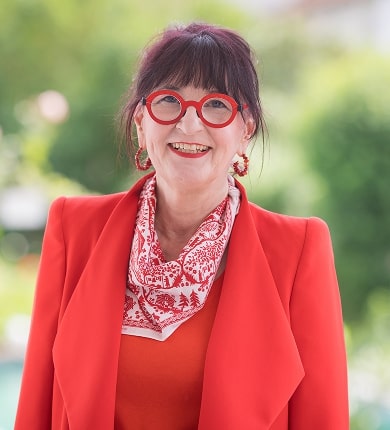
- Sylvia Dehnbostel
- Sylvia Dehnbostel possesses a diverse background in both medicine and the arts, which shapes her long-standing career in the field of epithetics. After training as a medical assistant and working in a specialist practice in Switzerland, she completed her nursing training at the University Hospital Basel between 1979 and 1982. Concurrently, she studied at the Basel School of Art.
- Subsequently, she worked in surgical and plastic surgery departments while deepening her artistic expertise through a part-time advanced study program focusing on anatomical design, modeling, and color theory. From 1985 to 1989, she served as a medical assistant and nursing instructor as part of a joint project involving three Swiss hospitals.
- In 1989–1990, Sylvia Dehnbostel pursued international specialization in epithetics and implant-supported prosthetics, training at institutions such as the University of Gothenburg in Sweden and the Epithetics Institute in Boston, USA. In 1990, she founded the “Institut für Epithetik” (Institute for Epithetics) with locations in Switzerland and Germany. In 1994, she achieved the first Europe-wide certification under DIN-EN-ISO standards.
- She has continuously expanded her expertise: in 1997, she was accredited by the Tracy College International Institute in Switzerland as a trainer for personal development and patient motivation. In 2010, she obtained certification as a “Certified Epithetist (dbve).” In 2018, she further enhanced her qualifications by obtaining additional certification in “Acrylic Eye Prostheses.”
- Today, Sylvia Dehnbostel combines medical expertise, anatomical understanding, artistic design skills, and years of practical experience to offer comprehensive, holistic expertise in the field of epithetics.
Facility / Institute / Clinic:
- Institut für Epithetik – Dehnbostel & Tesoro GbR
- Harburger-Heerstr. 27
- 29223 Celle, DE
Co-authors:
- Tina Tesoro
- Laura Zerres
- Falk Dehnbostel

Shipping “Weisse Flotte”
At the end of the congress, we will enjoy an enjoyable evening together on board of the “Weisse Flotte”.
Only a few tickets left